Building a Runway for Other People’s Dreams
Publish Date: 17 September 2024
By Mukul Ronak Das
Airports are fascinating places to observe human behaviour.
Most people are too occupied with their own journey to notice it, but every departure lounge is filled with stories in transit. A young graduate is travelling abroad for the first time and trying desperately to appear calmer than he feels. A couple in their sixties are beginning a holiday they have postponed for years because work, children, responsibilities and life itself always seemed to arrive before leisure. A business traveller is simultaneously responding to emails, speaking on the phone and balancing a paper cup of coffee with a level of confidence that suggests this is not his first rodeo.
Everyone is heading somewhere. More importantly, everyone believes something worthwhile awaits them at the other end.
I’ve spent a fair amount of time in airports over the years and one thought has returned to me more often than any other. Nobody buys a ticket because they are excited about the runway. Nobody photographs the runway. Nobody tells stories about the runway after they get home. The excitement belongs to the aircraft, the destination and the journey itself. Yet without the runway, none of it happens. It is perhaps the most important part of the entire process and also the least celebrated.
Strangely enough, I have come to believe that many of the most meaningful things in life work exactly the same way.
Years ago, during my banking career, I met a gentleman who wanted to start a business. He was intelligent, articulate and genuinely passionate about his idea. Every few months we would meet, and the conversation would inevitably drift towards this future venture he planned to launch. He had already decided what he would call the company. He had thought through the products. He had a view on branding, hiring, expansion and even the layout of the office. If enthusiasm alone could build companies, he would probably have been running a multinational corporation.
Five years later, however, he was still planning.
Around the same period, I met another gentleman who had become fascinated with scuba diving. He knew everything about it. The best locations, certification programmes, equipment, seasons, websites and instructors. If there were an Olympic event for researching hobbies, he would have qualified comfortably. The only thing he hadn’t done was actually go scuba diving.
For a long time, I assumed these stories were about fear. It seemed like the obvious explanation. People dream big, become nervous, and retreat into the comfort of routine. Over time, however, I realised the reality was usually far less dramatic. Most people are not paralysed by fear. They are overwhelmed by uncertainty. They don’t know what the first step looks like, and when the first step remains unclear for too long, the tenth step begins to feel impossible.
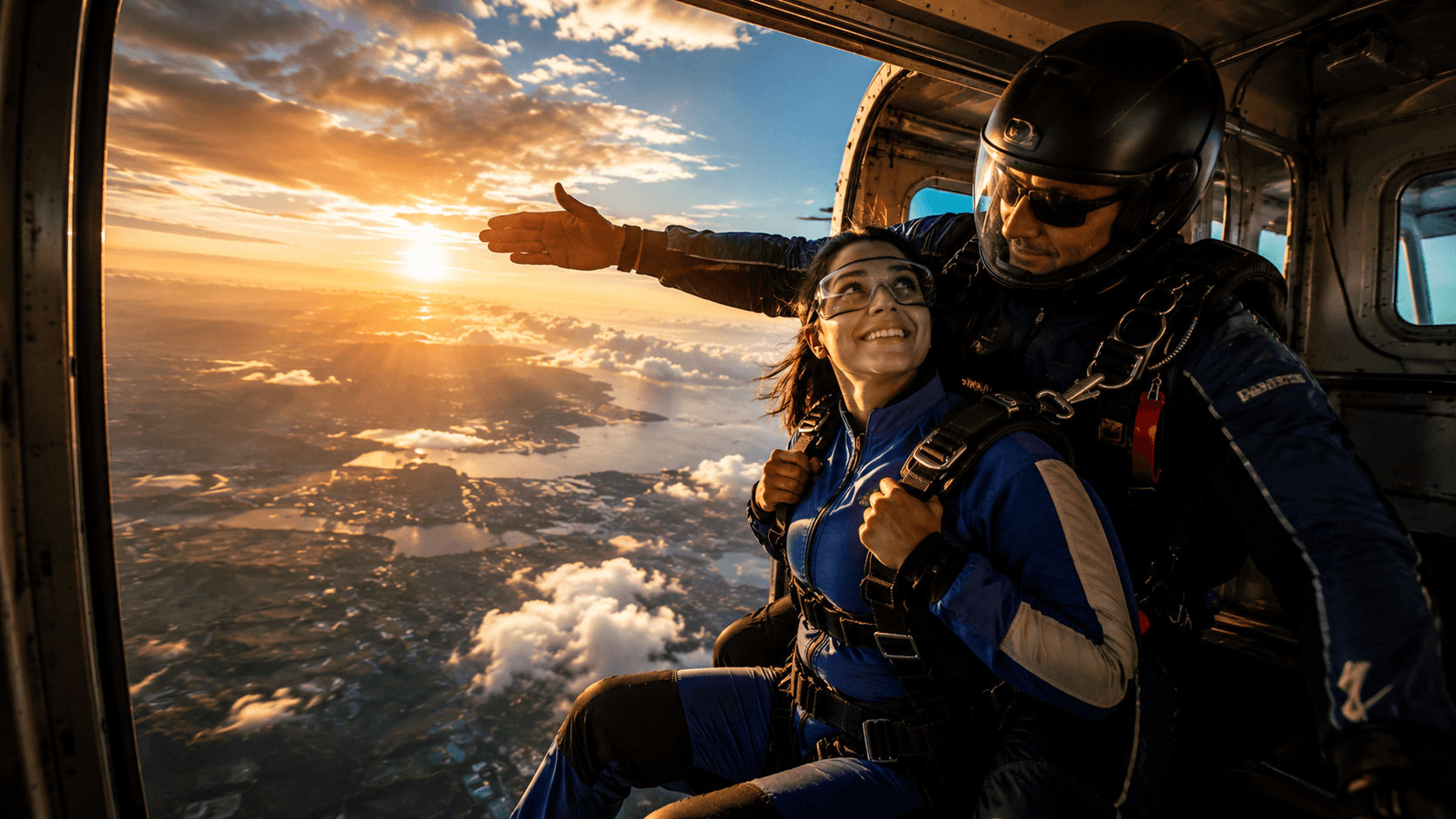
That observation became impossible to ignore when I found myself spending more time around skydiving and adventure sports. One of the biggest misconceptions people have about aspiring skydivers is that they are all adrenaline junkies. The reality is considerably less glamorous and far more interesting. Most of the people I met were remarkably ordinary. Software engineers, entrepreneurs, doctors, students, teachers, business owners and corporate professionals. The sort of people you might sit beside on a flight without ever suspecting that they had spent years dreaming about jumping out of an aircraft.
What fascinated me wasn’t the jump itself. It was the delay.
Many had wanted to do it for years. Not months, but years. One gentleman had been discussing skydiving with friends for so long that they had stopped believing he would ever do it. Another had promised himself he would do it before turning thirty and was now approaching his mid-thirties with alarming speed. A few had consumed enough videos, articles and online discussions to qualify as part-time researchers in the subject. Yet when you sat down and spoke to them, the obstacle was rarely what people assumed.
Most weren’t asking about adrenaline or bragging rights. They weren’t obsessed with how freefall felt or how exciting the photographs would look on social media. They wanted answers to much simpler questions. Who should they trust? Where should they begin? What was safe? What was realistic? What would the journey actually look like from start to finish?
The dream itself was never the problem.
The pathway was.
And somewhere during those years, a thought began forming in the back of my mind. Perhaps my role was not to become the world’s greatest skydiver. Perhaps my role was not even to become the most adventurous person in the room. Perhaps my role was to help make these journeys more accessible for other people.
That may sound obvious now, but at the time it was a surprisingly important realisation.
Most of us grow up believing the most exciting position is centre stage. We celebrate the athlete, the performer, the explorer, the entrepreneur and the adventurer. We admire visible achievements because they are easy to see. What we often overlook are the people quietly building the infrastructure that makes those achievements possible.
Every meaningful journey seems to have them. The teacher who sparks a lifelong interest in a subject. The mentor who provides guidance at precisely the right moment. The entrepreneur who creates access where none previously existed. The community builder who brings together people who might otherwise never have met. The parent who encourages curiosity instead of caution. The coach who provides confidence when self-belief is running low.
The older I get, the more I appreciate these people.
Because every memorable journey I have witnessed has depended on someone creating a pathway before the traveller ever arrived. The first-time entrepreneur needs one. The aspiring traveller needs one. The student needs one. The aspiring skydiver needs one. The dream changes, but the requirement remains remarkably consistent. People need clarity. They need confidence. They need a visible first step.
Looking back now, I think that simple idea explains far more about my journey than any job title ever could. Whether through adventure tourism, skydiving, entrepreneurship, community building or the effort to make world-class Indoor Skydiving accessible in India, the underlying motivation has remained remarkably consistent. I enjoy watching people surprise themselves. I enjoy watching somebody move from “one day” to an actual date on the calendar. I enjoy seeing a dream stop being a conversation and start becoming a plan.
The aircraft gets the applause. The destination gets the photographs. The achievement gets the recognition. Yet none of it happens without the runway.
Perhaps that is why airports continue to fascinate me. Every departure board is really a collection of dreams in motion. Some large. Some small. Some life-changing. Some wonderfully ordinary. Each one begins in exactly the same place.
Not in the sky.
On the ground.
On a runway that somebody took the time to build.
About the Author
Mukul Ronak Das is the Founder of Waltair Group, an adventure and experiential ventures company with roots in India’s early civilian skydiving ecosystem. Through its various initiatives, Waltair has worked towards making extraordinary experiences more accessible to everyday people. Waltair Group is the active candidature license holder for iFLY Indoor Skydiving in India and is working to introduce world-class Indoor Skydiving infrastructure and experiences across the country.