iFLY Bharat - India’s First Premium Indoor Skydiving Experience by Waltair Group
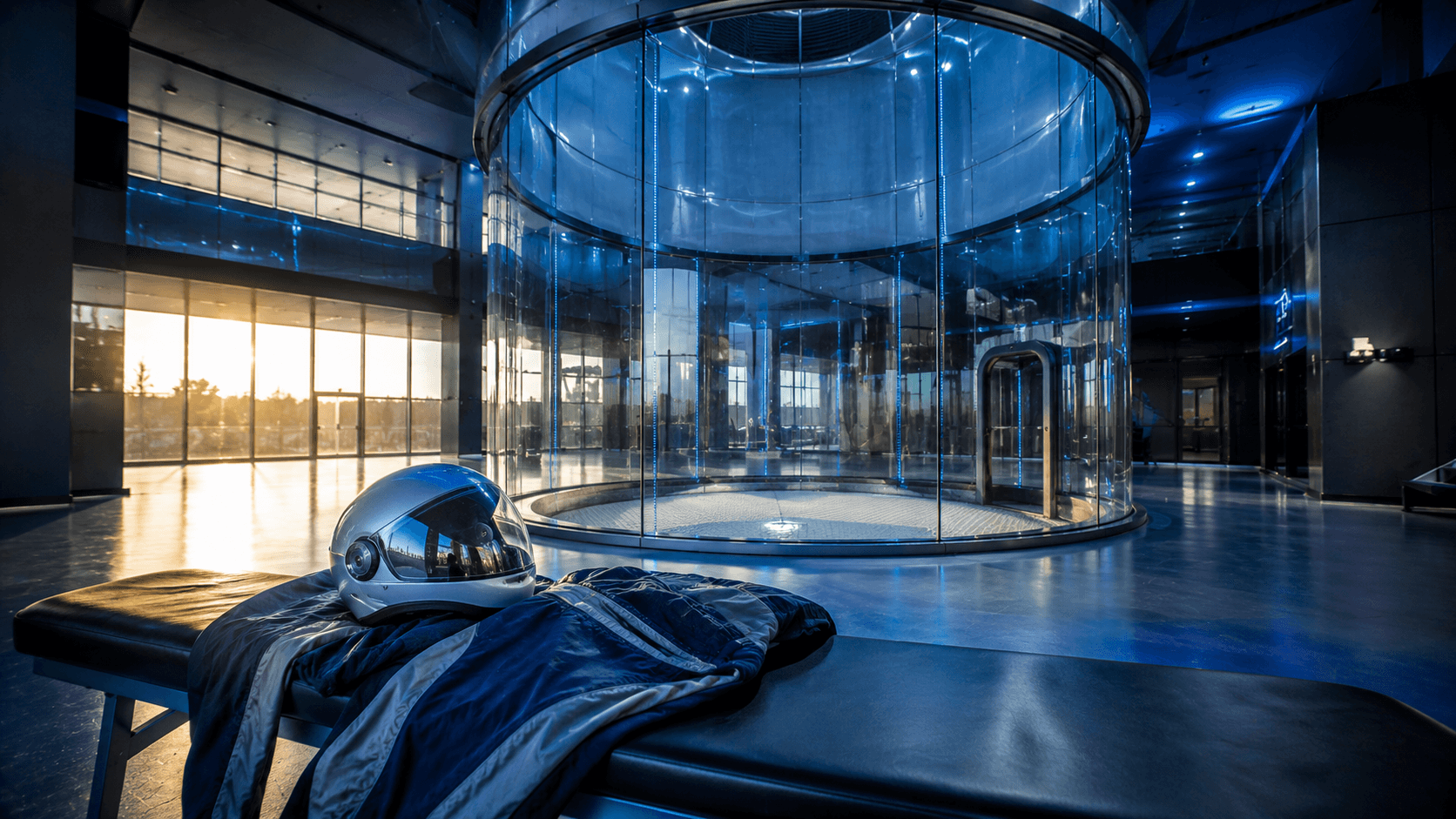
Before the Wind Rises
By Mukul Ronak Das
Aviation has a peculiar way of making adults behave like children.
Spend a few minutes near an active runway and you will notice it almost immediately. Conversations pause when an aircraft appears overhead. People instinctively look up. Cameras emerge from pockets. Someone inevitably begins discussing aircraft types despite having no formal aviation background whatsoever. Even those who claim no particular interest in flying often find themselves watching an aircraft disappear into the horizon a few seconds longer than necessary.
There is something about flight that continues to fascinate us long after we have become too old to admit fascination.
What makes this particularly interesting is that most people are perfectly content experiencing flight from a passenger seat. They enjoy the view from the window, tolerate the airline food and quietly celebrate a smooth landing. A much smaller group becomes curious about what lies beyond the conventional experience of flying.
I found myself drifting towards that second group.
The irony is that if someone had predicted this during my early years in banking, I would probably have laughed. Like many young professionals, I had followed a fairly conventional path. I completed my management education, entered the world of corporate banking and began building what appeared to be a sensible career. The salary arrived on time. The business card looked respectable. The future was reasonably predictable.
There was only one problem.
Predictability has never been particularly effective at silencing curiosity.
Around 2010, I found myself increasingly drawn towards travel, exploration and experiences that existed beyond the boundaries of conference rooms and quarterly targets. What began as curiosity gradually evolved into something more substantial. The more I travelled, the more I realised that extraordinary experiences had a remarkable ability to change people. Not permanently. Not dramatically. But enough to shift perspectives.
Travel does that.
Adventure does that.
The right experience at the right moment can stay with a person for decades.
Somewhere during that period, skydiving entered the picture.
At the time, skydiving in India occupied a curious position. People had heard of it. They had seen it in films. They had watched videos online. Many dreamed about doing it. Very few had any realistic pathway to actually experience it. The sport existed more as an aspiration than an accessible activity.
The deeper I explored the ecosystem, the more obvious the gap became.
There was demand.
There was curiosity.
There was fascination.
What was missing was access.
Looking back today, it is easy to underestimate how different the environment was fifteen years ago. Adventure tourism in India was still evolving. Concepts that are relatively familiar today were considered niche. The idea that ordinary civilians would voluntarily pay money to jump out of an aircraft seemed, to many people, entirely unreasonable.
The more people told me it couldn’t be done, the more interesting it became.
Entrepreneurs often describe a moment when a business idea begins to move from possibility to obsession. It is difficult to explain precisely when that transition occurs. One day it is an interesting thought. A few weeks later, it becomes the thing occupying your mind during long drives, quiet evenings and random conversations.
Skydiving gradually became that idea.
What followed was one of the most educational chapters of my life.
The phrase “India’s first commercial civilian skydiving venture” sounds neat and polished when written on a website. Reality was considerably less glamorous. There was no blueprint. No established ecosystem. No handbook explaining how to introduce civilian skydiving to a country where most people had never seen it up close.
Every challenge felt new because, in many ways, it was.
Aircraft availability was a constant puzzle. Airfields came with their own operational realities. Permissions required patience. Infrastructure had to be created. Awareness had to be built. Trust had to be earned. Even explaining the concept often felt like an exercise in storytelling.
People would ask sensible questions.
Is it safe?
Who does this?
Why would anyone do this?
The last question always fascinated me.
Not because it was difficult to answer.
Because it revealed something deeper.
The people asking were usually not questioning skydiving.
They were questioning possibility.
Human beings have a tendency to place extraordinary experiences into separate mental compartments. We admire them from a distance. We assume they belong to athletes, adventurers, celebrities or people somehow different from ourselves.
Then we meet someone who has actually done it.
And they turn out to be remarkably ordinary.
One of the most rewarding aspects of those years was watching that realisation unfold repeatedly.
The software engineer who had spent years talking about skydiving eventually showed up and did it.
The entrepreneur who analysed every possible risk eventually accepted that some experiences refuse to fit neatly inside spreadsheets.
The student who arrived nervous left with enough stories to last several family gatherings.
Again and again, the same pattern emerged.
Ordinary people were capable of extraordinary experiences.
They simply needed access.
That belief became the foundation of everything we were building.
Over the next few years, our journey took us across locations including Dhana, Mysore, Pondicherry and Baramati. Each location brought its own character, challenges and memories. Airfields have a personality that is difficult to explain until you spend time around them. They are simultaneously chaotic and disciplined, technical and romantic, practical and aspirational.
An airfield at sunrise possesses a certain magic.
The first aircraft is being prepared. The wind is being assessed. Equipment is being checked. Conversations begin quietly. The day has not yet revealed what stories it intends to create.
Then the aircraft starts flying.
Participants arrive.
Nervous laughter appears.
Questions multiply.
Photographs are taken.
And somewhere during the day, another person achieves something they had been postponing for years.
What fascinated me most was that the actual skydive was rarely the biggest story.
The bigger story was always what happened beforehand.
The years of hesitation.
The anticipation.
The internal negotiations.
The moment somebody finally stopped saying “one day” and chose a date.
Skydiving taught me many lessons, but perhaps the most valuable was this: people are far more capable than they believe.
Fear has a remarkable ability to exaggerate itself from a distance. Reality is often much kinder.
That observation extends far beyond aviation. I have seen it in business, travel, entrepreneurship and life itself. The experiences that ultimately shape us are often the same experiences we spend years postponing.
The civilian skydiving chapter eventually came to an end. Operational realities, infrastructure limitations and the practical challenges of sustaining such ventures in India created obstacles that were difficult to overcome at the time. Yet despite those challenges, I have never viewed those years as a completed story.
I view them as a foundation.
The lessons remained.
The relationships remained.
The fascination with human flight remained.
Most importantly, the belief remained that India deserved access to world-class flight experiences.
That conviction quietly stayed with me through banking, commercial real estate, coworking, entrepreneurship and every other chapter that followed. Some ideas disappear when circumstances change. Others simply wait for the right moment to evolve.
In many ways, the work we are doing today is not the beginning of a new story.
It is the continuation of an old one.
The technology has changed. The scale is different. The opportunity is significantly larger. Yet the mission feels remarkably familiar. It is still about accessibility. It is still about possibility. It is still about helping ordinary people experience something extraordinary.
The older I get, the more I realise that businesses are often built around products, but great ventures are usually built around beliefs.
The belief that people deserve access to experiences that inspire them.
The belief that curiosity should be encouraged rather than postponed.
The belief that wonder still matters, even in adulthood.
Those beliefs took me to airfields across India more than a decade ago.
They continue to guide the journey today.
And perhaps that is why, whenever I hear an aircraft overhead, I still find myself looking up for a few seconds longer than necessary.
Some fascinations never really leave you.