iFLY Bharat - India’s First Premium Indoor Skydiving Experience by Waltair Group
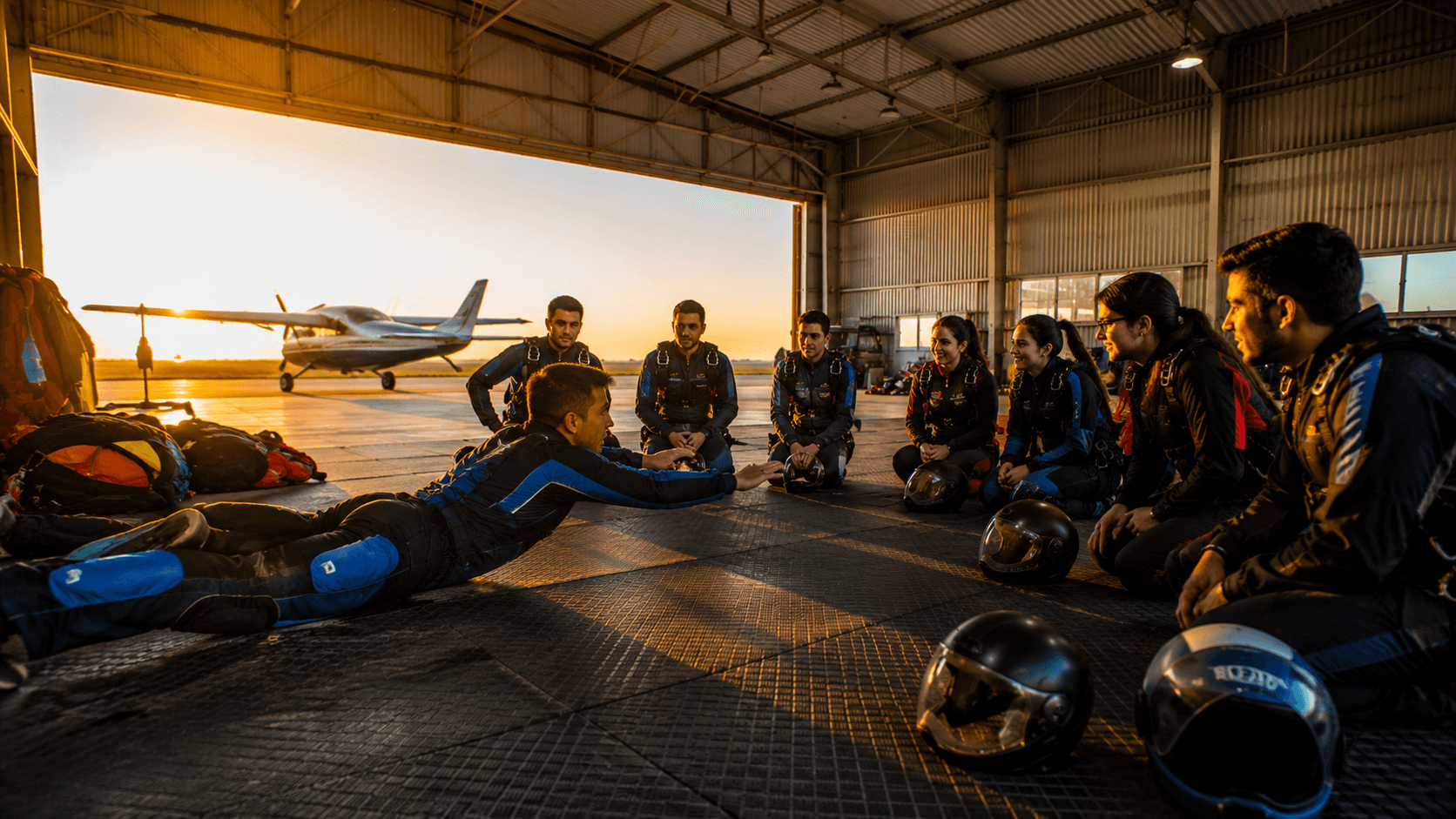
The Longest Part of a Skydive Happens on the Ground
By Mukul Ronak Das
One of the biggest misconceptions about skydiving is that it begins when the aircraft leaves the ground.
It doesn’t.
Nor does it begin when the aircraft door opens, when the wind rushes into the cabin, or even when a person takes that final step into open sky.
In my experience, the longest part of a skydive often starts months or even years earlier, usually in the quiet corners of someone’s mind.
It begins with a thought.
“I’d love to do that someday.”
That simple sentence has probably launched more adventures and simultaneously prevented more adventures than almost any other phrase in the English language. It carries excitement, possibility and aspiration. Unfortunately, it also carries an unlimited extension period. Someday is wonderfully flexible. It asks for no commitment, demands no action and rarely appears on a calendar.
Over the years, I met countless people who wanted to skydive. Some had discovered the sport through movies. Others had seen photographs online. A few had watched friends jump and decided that they too wanted to experience what it felt like to fly. The fascinating thing was that very few lacked enthusiasm. If excitement alone could get people into the sky, most would have completed their jump years earlier.
What they lacked was not desire.
It was a date.
I remember speaking to a gentleman who had wanted to skydive for nearly seven years. Seven years is a surprisingly long time to carry a dream. In that period, people complete degrees, change careers, move cities, get married and raise children. Yet somehow this particular ambition remained parked permanently in the future.
The funny thing was that he knew almost everything about the sport. He had read articles, watched videos, followed drop zones and spoken to people who had already jumped. By the time we met, he had accumulated enough information to comfortably participate in most conversations about skydiving.
The only thing missing was the actual skydive.
I have noticed a similar pattern in other areas of life as well. There are people who know everything about countries they have never visited, businesses they have never started and books they have never written. Human beings are remarkably talented at preparing for experiences they never quite get around to having.
The more I observed this behaviour, the more I realised that skydiving wasn’t the story at all.
Human nature was.
We often assume that people delay experiences because they are afraid. While fear certainly plays a role, I don’t think it tells the whole story. Most people are not paralysed by fear. They are trapped by the illusion that there will always be a better time.
Next month seems more convenient than this month.
Next year seems more sensible than this year.
The future always appears to contain a calmer schedule, fewer responsibilities and more certainty than the present.
The problem, of course, is that the future has a habit of arriving disguised as another busy present.
One of my favourite observations about aspiring skydivers is that they become extraordinarily creative when explaining why today is not the ideal day to jump. Some suddenly develop an advanced understanding of weather conditions. Others become fascinated by equipment specifications. A few discover concerns they had somehow managed to overlook during weeks of preparation.
I remember one participant who spent an impressive amount of time discussing wind speeds. Listening to him, you would have assumed he was preparing to present a paper at an international meteorology conference. The timing of this newly discovered passion for atmospheric science was particularly interesting because it emerged roughly thirty minutes before take-off.
Fear has a wonderful sense of timing.
What amused me wasn’t the behaviour itself. It was how familiar it felt. We do exactly the same thing in other areas of life. The entrepreneur spends years perfecting a business plan instead of launching the business. The traveller keeps researching destinations without booking a ticket. The aspiring author rearranges chapter outlines for the hundredth time without writing the first page.
The activity changes.
The psychology remains remarkably consistent.
That is why I have always believed that skydiving reveals far more about human beings than it does about aviation.
When most people think about skydiving, they focus on the jump. They imagine the aircraft, the altitude, the freefall and the parachute. They assume the challenge lies in stepping out of the aircraft.
The people who eventually jump know something different.
The real challenge usually happens beforehand.
It happens during the weeks leading up to the experience. It happens during conversations with friends. It happens during quiet moments when enthusiasm and doubt take turns presenting their arguments. It happens every time someone asks themselves whether they are really going to go through with it.
In many ways, the aircraft door is simply the final chapter of a much longer conversation.
One of my favourite descriptions of a skydiver is that a skydiver is someone who has taken off in an aircraft more times than he has landed in one. The line usually earns a laugh, but hidden within it is a deeper truth. Skydivers have a different relationship with uncertainty. Not because they enjoy risk more than everyone else, but because they have learned that some experiences cannot be understood from a distance.
At some point, observation must give way to participation.
Life has a habit of rewarding participation.
Travel is like that.
Entrepreneurship is like that.
Relationships are like that.
Skydiving certainly is.
You can read about Rome for years, but eventually you have to walk its streets. You can spend a decade discussing a business idea, but at some point you have to serve your first customer. You can watch hundreds of skydiving videos online, but none of them can answer the question that matters most.
What does it feel like for you?
That question cannot be outsourced.
It cannot be delegated.
It cannot be answered by someone else’s experience.
And perhaps that is why so many people describe skydiving in surprisingly emotional terms afterwards. They rarely begin by discussing technical details. They don’t talk about aircraft specifications or parachute systems. They talk about the view. The feeling. The perspective. The freedom. The strange calmness that appears once the noise inside their head finally disappears.
More often than not, they talk about one particular thought.
“I should have done this sooner.”
I have heard versions of that sentence countless times.
Not once have I heard somebody land and say, “I wish I had postponed it for another three years.”
That observation has stayed with me because it extends far beyond skydiving.
Many of our most memorable experiences sit patiently on the other side of action. Yet we spend years standing on the edge, imagining them instead of living them. We become spectators to our own ambitions. We wait for certainty, not realising that certainty rarely arrives before action. More often, it arrives afterwards.
This is one of the reasons I have developed enormous respect for first-time skydivers.
Not because they are fearless.
Most aren’t.
Not because they are reckless.
Most definitely aren’t.
I respect them because they eventually decide that curiosity deserves a chance.
That may sound simple, but it isn’t.
Curiosity is easy.
Action is harder.
Dreaming is easy.
Showing up is harder.
Talking about possibilities is easy.
Walking towards them is harder.
Every first-time skydiver I have met eventually arrives at the same crossroads. One path leads back towards another year of imagining. The other leads towards an aircraft, a parachute and an experience that may last only a few minutes but remain memorable for decades.
The remarkable thing is that skydiving is far more accessible than most people imagine. It is not reserved for elite athletes or professional adventurers. The vast majority of people who complete tandem skydives are ordinary individuals pursuing an extraordinary experience. They are teachers, engineers, parents, entrepreneurs, students and professionals. They carry the same doubts, fears and insecurities as everyone else.
The difference is not who they are.
The difference is that they eventually stop postponing.
Over the years, I have forgotten countless details about individual flights. I wouldn’t remember every conversation, every weather condition or every aircraft. What I do remember are the people. I remember the gentleman who spent seven years planning a skydive before finally arriving. I remember the participants who transformed from nervous observers into enthusiastic storytellers within a single afternoon. I remember the smiles that appeared after landing and refused to leave.
What fascinated me was never that these people jumped out of an aircraft.
It was that they finally stopped negotiating with themselves.
Perhaps that is why I continue to believe that the longest part of a skydive happens on the ground. It happens in living rooms, offices, coffee shops and airport lounges. It happens every time someone says, “I’d love to do that someday.”
The real question is whether someday eventually becomes a date.
Because once it does, something interesting happens. The dream stops being an idea and becomes an experience. The uncertainty gives way to understanding. The imagination finally makes room for memory.
And memories, unlike plans, have a habit of staying with us for a very long time.