iFLY Bharat - India’s First Premium Indoor Skydiving Experience by Waltair Group
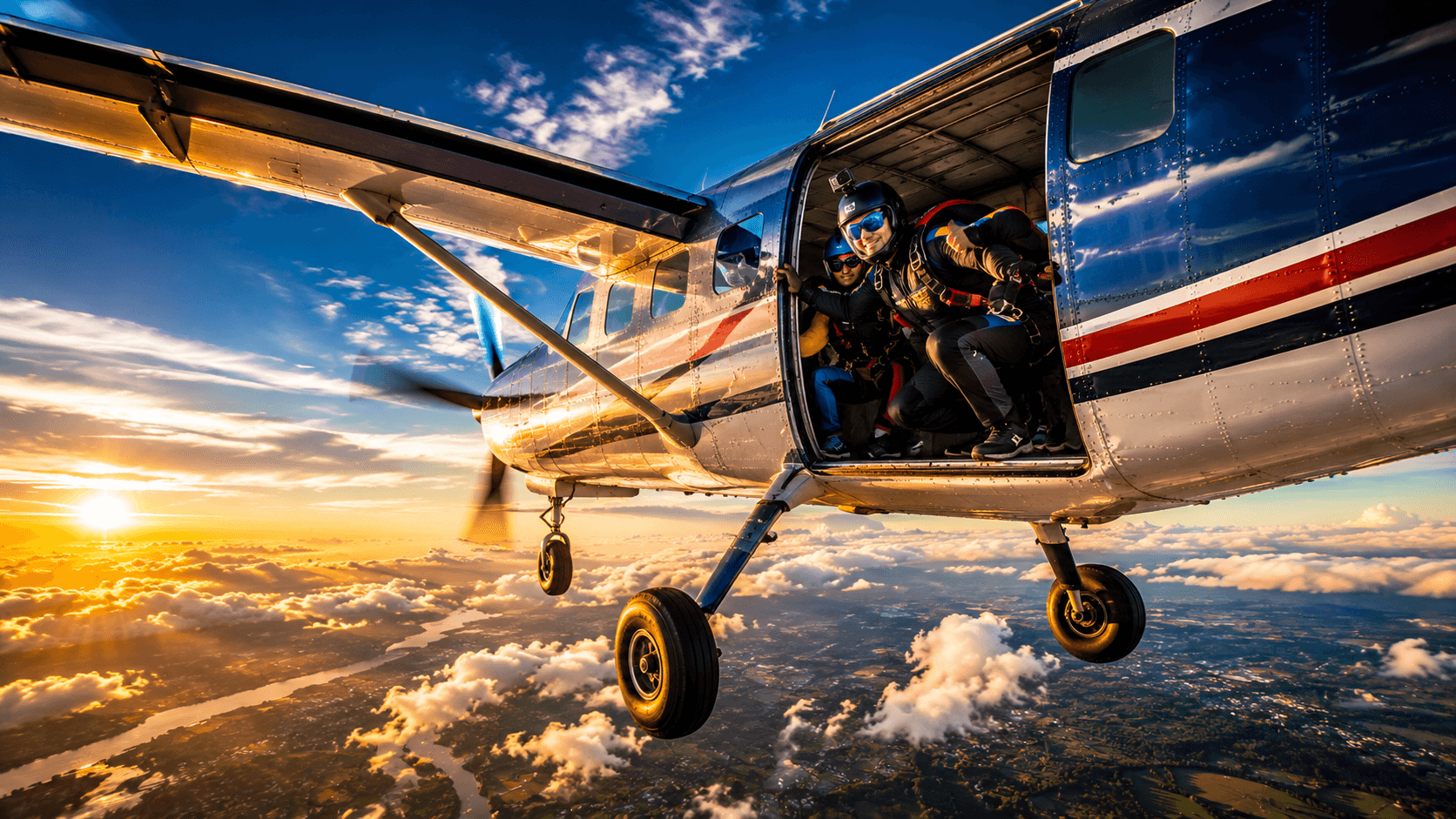
A Perfectly Good Aircraft
By Mukul Ronak Das
For most of human history, getting into an aircraft was considered a remarkable achievement.
People dressed up to fly. Families came to airports to see relatives off. Children pressed their faces against terminal windows to watch aircraft take off. Even today, despite delayed flights, security queues and the occasional disappearing suitcase that seems to have embarked on a different holiday altogether, there remains something faintly magical about climbing into a machine weighing several tonnes and watching it rise gracefully into the sky.
Which is why I have always found one particular category of airline passenger fascinating.
These are people who spend a considerable amount of time, money and effort getting into an aircraft, only to become surprisingly enthusiastic about leaving it before it reaches its destination.
The first time you encounter this behaviour, it feels irrational. The second time, mildly amusing. By the fiftieth time, you begin to suspect that the aircraft may not be the real story.
And that’s where things start getting interesting.
One of my favourite descriptions of a skydiver is that a skydiver is someone who has taken off in an aircraft more times than he has landed in one. The line usually earns a smile, but hidden inside the humour is a surprisingly profound observation. Most people view an aircraft as transportation. It exists to take them somewhere else. A business meeting, a holiday, a family gathering or a destination on a map. A skydiver sees something entirely different. To them, the aircraft is not transportation at all. It is an invitation.
The older I get, the more fascinated I become by invitations.
Not the kind printed on expensive paper or delivered through email. The quieter kind. The ones life presents occasionally. An invitation to start something. To attempt something. To stop postponing something. To discover whether the version of ourselves we imagine is actually capable of existing in the real world.
Over the years, I met hundreds of people who wanted to skydive. Engineers, entrepreneurs, doctors, teachers, software professionals, students, business owners and parents. If you met them at a coffee shop, you would never identify them as people preparing to leap into open sky. They worried about deadlines, school fees, mortgages, traffic jams and office politics exactly like everyone else.
That is perhaps the first myth worth dismantling.
Most people imagine skydivers as fearless thrill-seekers with a casual disregard for self-preservation. The reality is far more interesting. Most aspiring skydivers are wonderfully ordinary people. They simply happen to be curious enough to occasionally question the boundaries of their own comfort zones.
And comfort zones, I’ve noticed, are remarkably persuasive.
They rarely tell you not to pursue your dreams. That would be too obvious. Instead, they become masters of negotiation. They suggest waiting until work becomes less hectic. Until the economy improves. Until the children grow older. Until you lose a little weight. Until you save a little more money. Until next summer. Until next year.
Comfort zones are patient.
Dreams often are too.
Time, unfortunately, is not.
One gentleman I met had wanted to skydive for nearly seven years. His friends had heard about the plan so often that they no longer believed it would ever happen. Every New Year brought a fresh declaration. Every birthday came with renewed enthusiasm. Every few months, a documentary, a YouTube video or a social media post would reignite the dream.
Then life would intervene.
Work became busy. Travel plans changed. Priorities shifted. There was always a reason. Not a bad reason. Just a reason.
When he finally arrived, what fascinated me wasn’t his excitement. It was his curiosity. Suddenly, he wanted to know everything. How old was the aircraft? How often was it serviced? How many jumps had the instructors completed? What were the wind conditions? What happened if the weather changed?
It was an impressive collection of questions.
The timing was even more impressive.
Fear has a wonderful sense of timing.
It rarely appears when you make the booking. It usually arrives much later, often after the payment has been made and there is no convenient escape route available.
What struck me over the years was that very few people were actually afraid of the jump itself.
They were afraid of the decision.
There is a difference.
The jump lasts a few minutes.
The decision can take years.
That observation has stayed with me because it extends far beyond skydiving. I have seen exactly the same pattern in entrepreneurs launching businesses, travellers planning journeys, aspiring authors talking about books they intend to write and professionals considering career changes. Human beings often spend far more time negotiating with themselves than they spend actually doing the thing.
The imagined experience becomes larger than the real one.
The fear becomes more elaborate than the reality.
The uncertainty becomes heavier than the action itself.
Then something interesting happens.
They begin.
And once they begin, the story changes.
One of the reasons I enjoyed being around aspiring skydivers was that they offered a front-row seat to this transformation. Some became unusually quiet as the aircraft climbed. Others became unusually talkative. A few developed a sudden and urgent interest in weather conditions despite having ignored meteorology for most of their lives. One gentleman spent nearly twenty minutes discussing cloud formations with the seriousness of a climate scientist.
Fear has a habit of discovering new hobbies.
Yet beneath all those different personalities sat the same question.
Not “Is skydiving safe?”
Not “How fast do we fall?”
Not even “What does freefall feel like?”
The real question was much simpler.
“What will I discover about myself once I do this?”
That is why I have always felt that people misunderstand skydiving.
From a distance, it appears to be about falling.
The people who have actually done it rarely talk about falling.
They talk about perspective.
They talk about freedom.
They talk about the strange calmness of looking at the world from an entirely different angle.
They talk about the view.
They talk about the smile that stubbornly refuses to leave their face afterwards.
Most importantly, they talk about wishing they had done it sooner.
The irony is that skydiving is often portrayed as an extreme activity reserved for a select few. In reality, tandem skydiving has introduced countless ordinary people around the world to the experience of human flight. Teachers have done it. Grandparents have done it. Newlyweds have done it. Corporate executives have done it. Students have done it. People celebrating birthdays, anniversaries, retirements and personal milestones have done it.
The barrier is rarely physical.
It is usually psychological.
The aircraft doesn’t ask whether you’re an adventurer.
The sky doesn’t ask whether you’re fearless.
The experience simply asks whether you are willing to trust the process and take a step towards something you have been imagining for a long time.
The dream of flight is one of humanity’s oldest fascinations. Long before aircraft, long before parachutes and long before modern aviation, people looked at birds with equal parts admiration and envy. Every generation has found its own way of exploring that fascination. Some learned to fly aircraft. Some became skydivers. Today, technologies like Indoor Skydiving are introducing entirely new audiences to the sensation of flight, making an experience that once seemed distant far more accessible than ever before.
The technology evolves.
Human nature doesn’t.
People still want wonder.
People still want stories.
People still want moments that remind them life is meant to be experienced, not merely observed.
Over the years, I have forgotten countless details about individual flights. I couldn’t tell you the weather on many of those days. I wouldn’t remember every aircraft registration or every conversation. Yet what has stayed with me are the people.
I remember the software engineer who spent seven years talking about skydiving before finally turning up. I remember the entrepreneur who approached the experience the way he approached business, by trying to calculate every possible variable before eventually accepting that some experiences simply refuse to fit neatly inside a spreadsheet. I remember the school teacher who arrived terrified, landed smiling and spent the rest of the afternoon telling complete strangers that they needed to stop postponing things.
What fascinated me was not that these people jumped out of an aircraft.
It was that they finally stopped negotiating with themselves.
At some point, every aspiring skydiver arrives at the same crossroads. One road leads back towards another year of imagining, researching and promising that someday will eventually arrive. The other leads towards an aircraft, a parachute and an experience that, for a few unforgettable minutes, makes the world look entirely different.
The remarkable thing is that skydiving is not reserved for extraordinary people. Most of the people I met were wonderfully ordinary. They had jobs, responsibilities, insecurities, doubts and fears just like everyone else. The only meaningful difference was that one day they stopped treating the dream as a spectator sport.
They showed up.
They trusted the process.
They took the leap.
And afterwards, almost none of them spoke about the fear.
They spoke about the view.
They spoke about the freedom.
They spoke about how quickly the ground seemed to disappear and how strangely calm the sky felt.
Most of all, they spoke about wishing they had done it sooner.
Perhaps that is why I continue to find perfectly good aircraft so fascinating. Not because people leave them, but because of what happens when they do. For a brief moment, somewhere between the earth below and the horizon stretching endlessly ahead, people discover something that had very little to do with aviation and everything to do with possibility.
The aircraft was never really the story.
The story was always the person who finally decided to board it.