iFLY Bharat - India’s First Premium Indoor Skydiving Experience by Waltair Group
What Actually Happens During Your First Skydive?
By Mukul Ronak Das
If Hollywood were responsible for introducing people to skydiving, one could be forgiven for imagining that a first skydive begins with dramatic music, nervous sweating, last-minute speeches and a tremendous amount of shouting.
The reality is disappointingly normal.
And that, strangely enough, is one of the most reassuring things about it.
Over the years, I have spoken to countless people who were curious about skydiving. Some eventually went on to complete a tandem skydive. Others kept the dream alive for a future date. Regardless of whether they actually jumped, the questions were remarkably similar. What does it feel like? Is it terrifying? Do you feel your stomach drop? What if you panic? How safe is it? What happens if something goes wrong? How much control do you actually have?
The interesting thing is that most people spend far more time worrying about the experience than experiencing it. A tandem skydive may last a few unforgettable minutes, but the anticipation often begins weeks, months or even years beforehand. The imagination gets to work immediately. It starts creating scenarios, assumptions and expectations. Some are accurate. Most are not.
The purpose of this article is not to convince anyone to skydive. Rather, it is to explain what actually happens when someone finally decides to stop imagining the experience and turns up to live it.
The first surprise for most people is how ordinary the morning feels.
There is no dramatic atmosphere. Nobody is behaving as though they are preparing for a life-or-death mission. The instructors are usually calm, relaxed and quietly focused. The aircraft sits patiently on the tarmac. Other participants are often chatting, taking photographs, drinking coffee or pretending to be calmer than they actually feel. It resembles the beginning of an interesting day rather than the beginning of an extreme adventure.
That calmness is important because it gradually begins replacing imagination with reality.
Fear thrives in uncertainty. It feeds on the unknown. Once people arrive and start seeing the process unfold, many of their concerns begin to shrink naturally. The aircraft becomes a real aircraft instead of an abstract idea. The instructors become real people instead of anonymous experts. The equipment becomes something tangible rather than something mysterious.
The next stage usually involves paperwork and a safety briefing. This is not the glamorous part of skydiving, but it may be one of the most important. Professional skydiving operations are built around systems, procedures and discipline. Most first-time participants are surprised by how methodical the entire process feels. The popular image of skydiving tends to focus on adventure and excitement. The reality behind the scenes is often far more structured.
A good briefing serves another purpose as well. It provides clarity.
Many fears are simply unanswered questions wearing different clothes. Once people understand what is expected of them, how the jump works and what their role will be, their confidence grows considerably. The unknown begins to become known.
For first-time skydivers, the most common route is a tandem skydive. In simple terms, this means being securely attached to a highly trained instructor who handles the technical aspects of the jump. The participant does not need prior experience, specialised training or advanced knowledge of parachute systems. Their job is surprisingly straightforward. Listen carefully, follow instructions and enjoy the experience.
This is often the point where another misconception disappears.
Many people assume skydiving requires extraordinary bravery. In reality, modern tandem skydiving was designed specifically to make the experience accessible to ordinary people. The school teacher, the software engineer, the entrepreneur, the student and the retired grandparent all stand on equal footing. The sky is remarkably indifferent to job titles.
As the time for boarding approaches, something fascinating begins to happen.
People reveal themselves.
One person becomes unusually quiet. Another becomes unusually talkative. Someone starts taking photographs of everything in sight. Another suddenly develops a deep interest in weather conditions despite having ignored meteorology for most of their life. Human beings have an endless capacity for creative behaviour when anticipation enters the room.
I once met a gentleman who spent nearly twenty minutes discussing wind speeds before his jump. Listening to him, you would have assumed he was preparing a presentation for an aviation conference. The reality, of course, was much simpler. He was nervous.
Not terrified.
Not panicked.
Just nervous.
And that is perfectly normal.
There is a misconception that courage and nervousness cannot coexist. The truth is that they often travel together. Some of the most courageous decisions people make happen while they are nervous.
Eventually, it is time to board the aircraft.
This is where reality truly takes over.
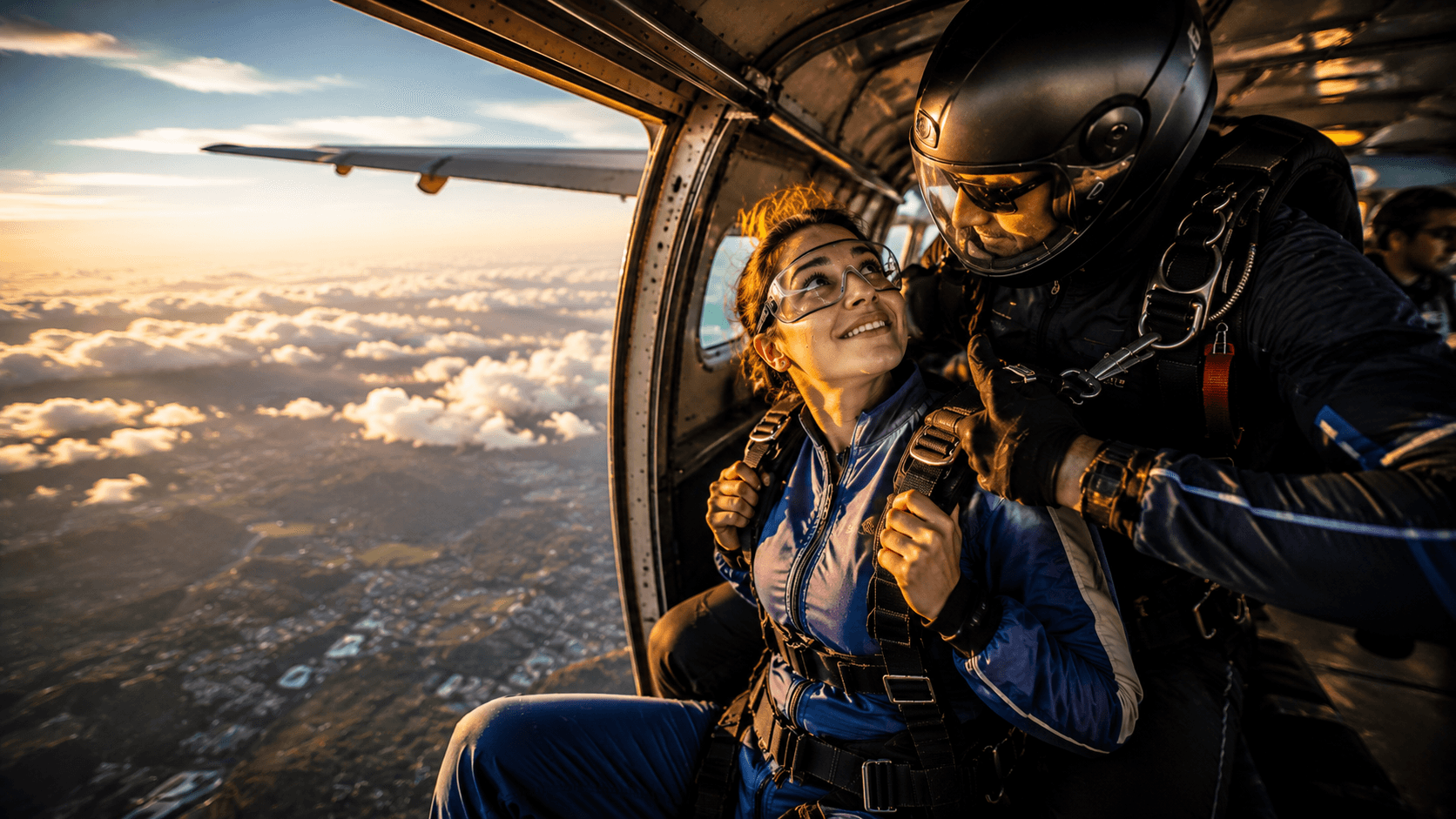
The aircraft ride itself is usually much quieter than people expect. The world outside the window slowly transforms. Roads become lines. Buildings become shapes. Cars become tiny moving dots. Familiar landscapes begin to look entirely different. Even people who have flown commercially before are often surprised by how different this feels. In a commercial flight, the destination is somewhere else. In a skydiving aircraft, the destination is the experience itself.
One of my favourite descriptions of a skydiver is that a skydiver is someone who has taken off in an aircraft more times than he has landed in one.
The quote is amusing, but it also highlights something profound. Most passengers view an aircraft as transportation. Skydivers view it as a doorway.
As altitude increases, participants often experience a curious shift. The fear they felt on the ground begins to change shape. Many discover that the anticipation was actually more uncomfortable than the reality. They spent days imagining the moment. Now that the moment has arrived, there is no longer anything left to imagine.
There is only participation.
This is a lesson that extends well beyond skydiving.
The entrepreneur launching a company often discovers that starting is easier than months of worrying about starting. The traveller boarding a flight frequently finds that the journey feels less intimidating than the anticipation of the journey. The aspiring public speaker often realises that giving the speech is less stressful than imagining the speech.
Human beings are surprisingly good at handling reality.
It is uncertainty that tends to cause trouble.
Then comes the moment everyone thinks about.
The aircraft door opens.
What happens next is difficult to describe accurately because it rarely matches people’s expectations. Popular culture has conditioned us to imagine screaming, panic and overwhelming sensory overload. Yet many skydivers describe something completely different. Instead of chaos, they remember clarity. Instead of fear, they remember focus. Instead of confusion, they remember presence.
For perhaps the first time in a long while, there is nothing else competing for attention.
No emails.
No meetings.
No notifications.
No unfinished tasks.
No social media.
No traffic.
No distractions.
There is simply the experience.
People often ask whether you feel your stomach drop.
The answer surprises many first-timers. The sensation is not usually comparable to a roller coaster. Freefall feels less like falling and more like flying. The wind becomes a powerful cushion of air. The experience is dynamic, intense and exhilarating, but not necessarily in the way most people imagine.
And then, almost as quickly as it begins, another transformation occurs.
The parachute opens.
The noise reduces dramatically.
The pace slows.
The world expands.
For many people, this becomes the most memorable part of the entire experience. Suspended beneath a canopy, with the landscape stretching in every direction, participants often experience something they did not expect.
Calm.
It is difficult to explain until you have experienced it, but there is something profoundly beautiful about viewing the world from above with nowhere else to be and nothing else demanding your attention.
Eventually, the ground approaches once again. The landing is completed, equipment is removed and the experience comes to an end.
Or at least that is what appears to happen.
In reality, something else begins.
The storytelling.
People start calling friends. They send photographs. They relive the experience. They talk about the view, the freefall, the aircraft ride and the feeling of stepping beyond a boundary they had imagined for years. More often than not, they repeat one particular sentence.
“I should have done this sooner.”
I have heard countless versions of that observation over the years.
What fascinates me is that very few people regret the jump itself. The regret, if it exists at all, is usually about waiting so long.
That is perhaps the most important thing to understand about a first skydive. While the experience involves aircraft, parachutes and altitude, the real story is rarely about any of those things. The real story is about possibility. It is about curiosity. It is about discovering that many of the barriers we imagine are far larger in our minds than they are in reality.
Skydiving is not for everyone, and it doesn’t need to be. Yet for those who have ever looked up at the sky and wondered what it might feel like to experience flight in its most personal form, the opportunity is far more accessible than many realise.
After all, every skydiver starts in exactly the same place.
On the ground.
Wondering what it would feel like.